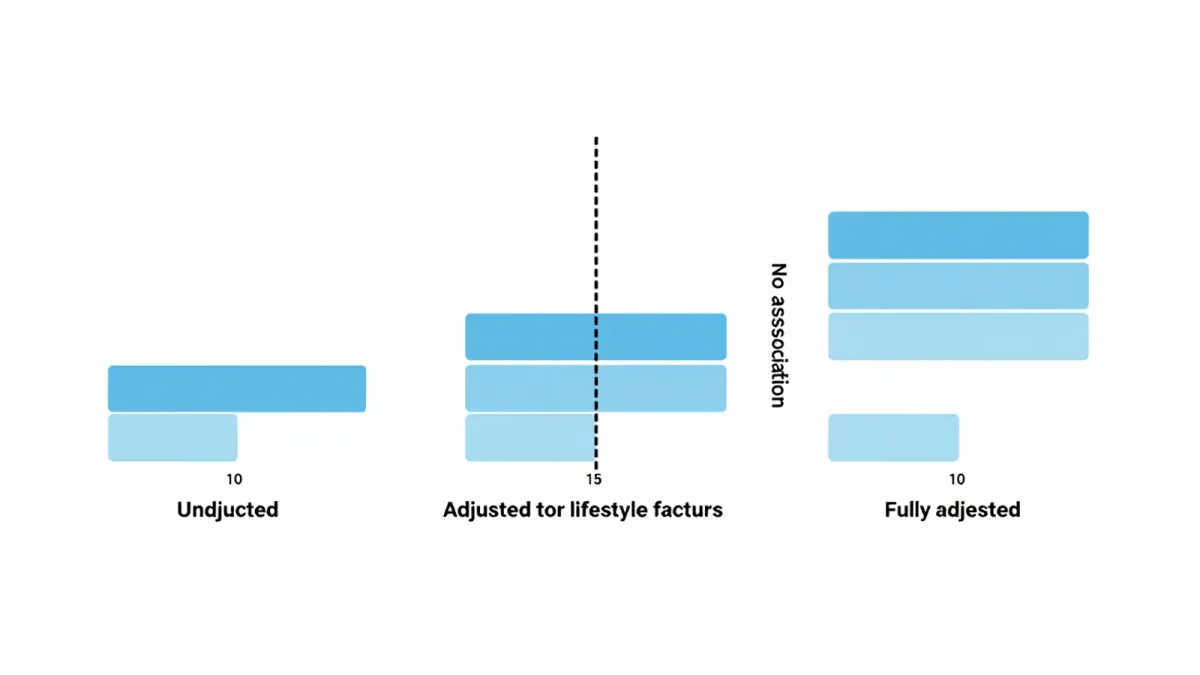

Adults who mixed the widest range of exercise types — walking, cycling, swimming, strength work and more — had a 19% lower risk of premature death than those with the least variety, per a study published January 20, 2026 in BMJ Medicine, led by researchers at the Harvard T.H. Chan School of Public Health using more than 30 years of follow-up from two large US cohort studies. Variety appeared to matter independently of how much total activity people logged.
The study is observational: it links variety with outcomes but cannot prove variety itself caused them, and anyone with a medical condition should clear a new training plan with a clinician.
What the researchers actually found
The analysis drew on more than 111,000 adults from the Nurses' Health Study and the Health Professionals Follow-Up Study, tracked for over three decades, per the Harvard Chan School's January 20, 2026 announcement. Lead authors Han Han and Jinbo Hu compared participants' activity repertoires over time. Even when total physical activity was held constant, the highest-variety group kept its lower mortality risk, and the association persisted across all activity levels.
Corresponding author Yang Hu, of the Department of Nutrition, noted there may be added benefits to doing multiple activity types rather than one. The authors flagged two limits: exercise data were self-reported, and both cohorts are composed largely of white health professionals, which limits how far the result generalizes.
What it changes for everyday exercisers
If your week is already full, this is not an order to add hours — the benefit held at every volume of activity. It is permission to swap, not stack. Trade one easy cardio session for a strength session, or add a swim where a second run used to sit. Different activity types stress different systems: cardio conditions the heart and lungs, lifting preserves muscle and bone, and balance-heavy work protects against falls later in life.
A simple pattern that fits the finding: two to three cardio sessions, two strength sessions, and one playful or skill-based session — a class, a hike, a court sport — across a week. That is a commonly used layout, not a prescription.
The context most coverage skipped
Most write-ups framed this as a new reason to diversify. The more useful context is what the study quietly confirms: total activity still dwarfs variety as a predictor. Participants who moved the most fared better regardless of how many activities they did, so a runner who loves running should not panic-read this into a program overhaul. Variety is a bonus layer on top of the base, not a replacement for it — a distinction the headlines flattened.
It also matters that the cohorts were health professionals. People in these studies tend to have better baseline health access than the general population, which can make risks look smaller and benefits cleaner than they would in a broader sample.
Frequently asked questions
Does variety matter more than walking 10,000 steps?
No. The study found the lowest mortality risk among people who moved more and varied more, per the January 20, 2026 report. Volume remains the stronger predictor; variety added an independent association on top of it.
How many activity types do I need?
The study compared high- versus low-variety groups rather than testing a target number, per Harvard Chan School. A practical mix most general guidelines converge on is cardio, strength, and some balance or mobility work each week.