
You cannot out-train eight seated hours, but you can defuse them: research on breaking up sitting shows that two-to-three-minute movement breaks every half hour meaningfully blunt the glucose and insulin spikes a desk day produces. In a 2012 study by Dunstan and colleagues in Diabetes Care, two minutes of light walking every 20 minutes cut post-meal glucose by about 24 percent compared with uninterrupted sitting. The strategy for desk workers is layers — a real workout where possible, plus frequent small movement all day.
If you have joint pain, a heart condition, or any medical concern, check your plan with a clinician before changing activity levels.
What is NEAT and why does it matter?
NEAT — non-exercise activity thermogenesis — is every calorie you burn outside sleep, eating, and formal exercise: walking to the printer, standing in meetings, pacing on calls, climbing stairs. Research by James Levine and colleagues, summarized in his 2005 work in Science on posture allocation, found NEAT varies enormously between people of similar size, and that differences in daily standing and walking could account for hundreds of calories — in some comparisons over a thousand — burned or stored per day.
For a desk worker, this is the lever that matters. One gym hour cannot offset the arithmetic of the other fifteen waking hours, but NEAT runs through all of them. Sedentary behavior itself has grown too: an analysis by Liu and colleagues in JAMA found American adults' average daily sitting time rose to over six hours by 2016.
Is sitting really harmful if I exercise?
Regular exercise lowers risk substantially — that part is settled, and the CDC's activity guidelines make clear that 150 weekly minutes of moderate activity plus two strength sessions deliver most of the measured benefit. What the research on sedentary time adds is that long uninterrupted sitting carries some residual associations of its own, and that they shrink when sitting is frequently interrupted.
What the sources did not establish
- An exact safe threshold of daily sitting below which risk disappears.
- Whether standing desks alone, without movement, deliver the same benefits as frequent walking breaks.
- That the associations are purely causal — sedentary time tracks with other habits in observational data.
How often should you move during the workday?
At least every 30 minutes, briefly. The Dunstan study used breaks every 20 minutes and showed clear metabolic effects; later research on break frequency broadly supports the every-half-hour rhythm as practical and effective. The breaks are short and light — two to three minutes of walking, stair climbing, or standing tasks. Intensity is not the point; frequency is.
| Layer | What it looks like | Evidence anchor |
|---|---|---|
| Breaks | 2–3 min movement every 30 min | Dunstan et al., 2012, Diabetes Care |
| NEAT | Walk calls, stairs, park far | Levine et al., 2005, Science |
| Formal exercise | 150 min/week + 2 strength sessions | CDC guidelines |
What can you actually do at a desk job?
- Set a recurring timer — a calendar ping every 30 minutes named "stand up." The cue matters more than the app.
- Walk one call per hour. Phone calls are portable; use them.
- Take the long route deliberately: far parking spot, stairs for one flight, the far restroom, the printer two floors down.
- Do sit-to-stands from your chair — ten every break trains the legs and needs no equipment.
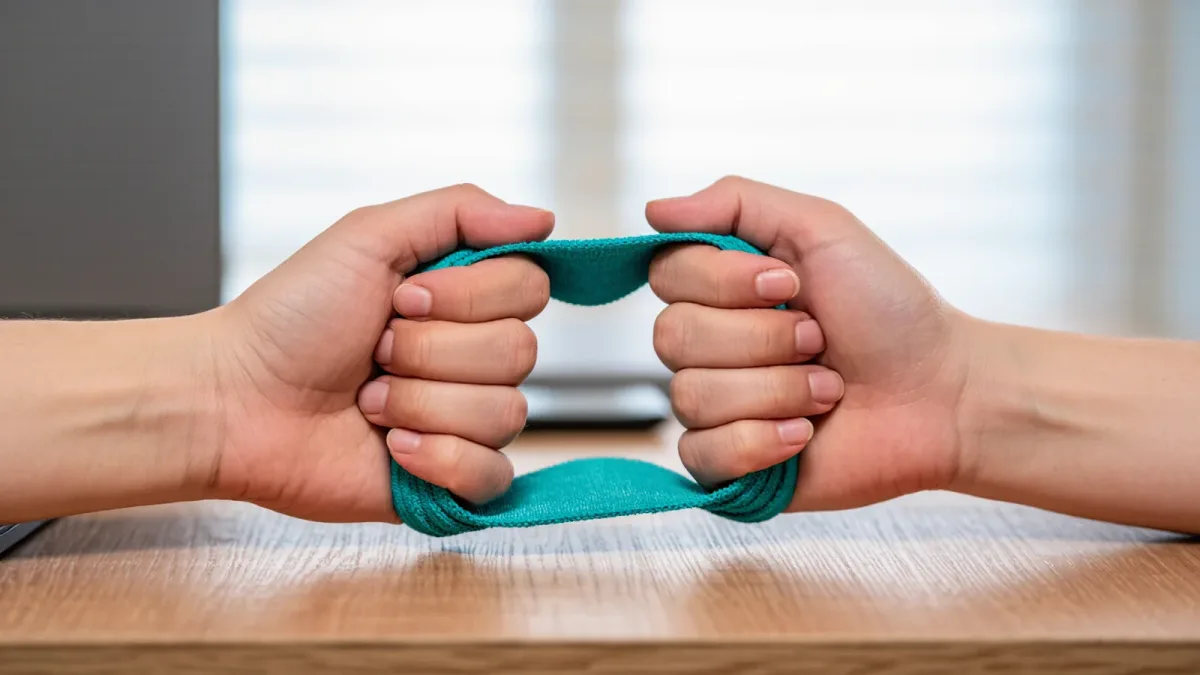
- Keep a resistance band in the drawer for two-minute sets between meetings.
- Drink water steadily — the refill trips and the resulting walks schedule themselves.
- If you use a standing desk, alternate positions rather than standing all day; the goal is variation, not a new static pose.
How do you build the workout layer?
Anchor exercise to the commute edges or lunch hour, and start smaller than feels impressive: two 30-minute sessions a week plus one strength session beats an ambitious plan that dies in week three, per the habit research. Lunch-hour walks deserve special mention — daylight exposure supports circadian rhythm, and a brisk 20 minutes is half the CDC's weekly target by Friday.
When to see a professional
Back pain, numbness, or joint pain that appears with sitting or flares when you stand up deserves assessment rather than a stretch video — see a clinician or physical therapist. The same applies to any cardiovascular symptoms during activity: stop and get evaluated before continuing a new routine.
The bottom line
The desk job is not a sentence. Break up sitting every 30 minutes with two or three minutes of movement, multiply small NEAT choices across the day — research on posture allocation shows those choices are worth hundreds of daily calories — and put a real workout layer on top. Frequency first, intensity later, and the arithmetic starts working in your favor.
FAQ
Is a standing desk enough to offset sitting?
No. Standing burns only slightly more energy than sitting and replaces one static posture with another. The measured benefits in the research come from movement, not posture change — the Dunstan trial used light walking breaks. Use a standing desk as one position in rotation, and keep the movement breaks as the actual intervention.
How many steps should a desk worker get?
Step-count research does not set a desk-specific number, but the general evidence points to a mortality-benefit plateau around 6,000–8,000 steps for adults 60 and older and 8,000–10,000 for younger adults, per the 2023 Lancet Public Health meta-analysis. A sedentary worker adding two or three 10-minute walks typically adds 3,000–4,000 steps — a meaningful move up the curve.
Do short movement breaks really help if I train every evening?
Yes — they address a different problem. Evening training delivers the fitness stimulus; the daytime breaks blunt the metabolic effects of uninterrupted sitting, as the Dunstan study showed even in people without formal exercise programs. Think of them as protecting the workday, not replacing the workout. Both layers fit in the same week.
What are the best stretches for a desk worker?
Helpful moves target what sitting shortens: hip flexor stretches, chest openers in a doorway, and neck stretches for screen posture. But movement beats stretching for the sedentary problem itself — walking breaks reverse the glucose effects that static stretches do not. If stretching causes pain rather than mild tension, get assessed before continuing.