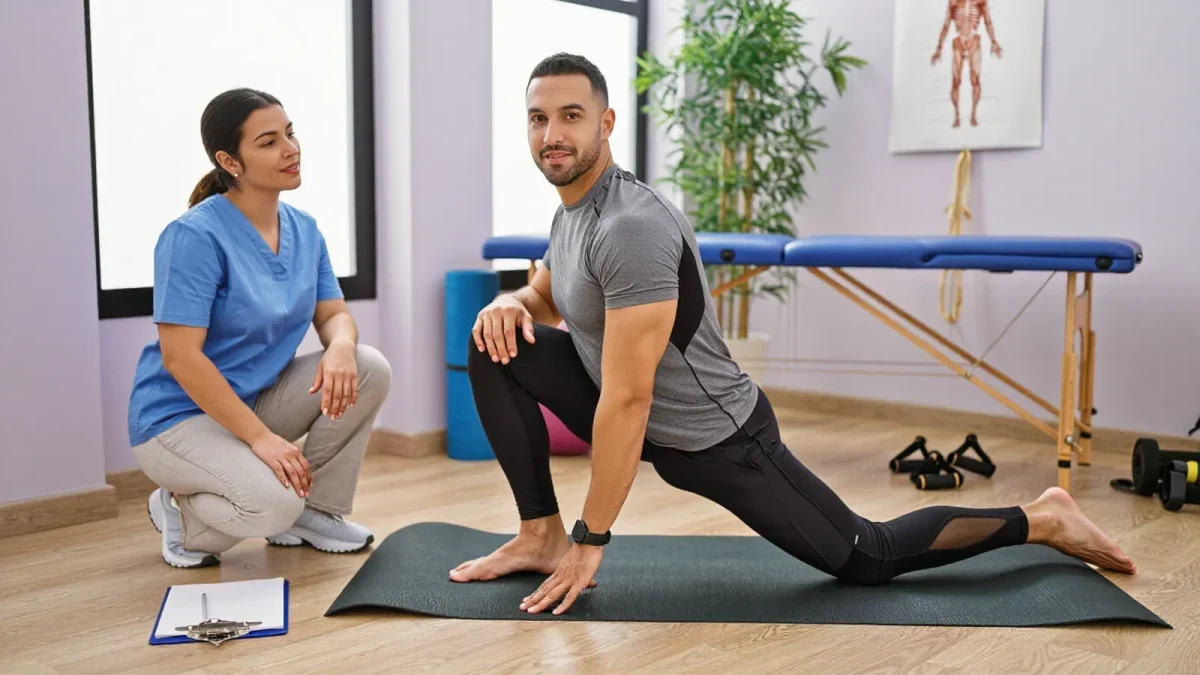

Short answer: stretching makes your hamstrings tolerate more range — it does not obviously make the muscle longer — and for athletes, strength training may protect the hamstrings better than flexibility work does. A 2019 meta-analysis in Sports Medicine by van Dyk and colleagues found that adding the Nordic hamstring exercise to prevention programs roughly halved hamstring injury rates, while stretching studies show reliable but more modest range gains. Here is what each tool is actually for.
A hamstring strain, persistent pain, or a diagnosed condition deserves assessment by a clinician or qualified professional before you train through it.
What happens when you stretch a hamstring?
The honest mechanism matters. Stretching research has shifted toward a tolerance model: regular stretching raises the range you can comfortably accept rather than permanently adding length to the muscle. Range improves reliably — the ACSM's 2018 guidance recommends flexibility work at least 2–3 days per week, with daily practice most effective — but the tissue is not being physically lengthened like taffy, and claims that stretching "releases" or "lengthens" muscle oversell it.
Whether more passive flexibility prevents hamstring injuries is contested. Reviews of risk factors, including a 2012 review by Opar and colleagues in Sports Medicine, point to strength, fatigue, and sprint-load management as major players — not flexibility alone. Some studies find tightness predictive; others do not.
So is stretching useless?
No — it is just aimed at a different target. Stretching improves range, which matters for deadlift setups, deep hinge patterns, gymnastics-adjacent goals, and simply bending over without a negotiation. A 2013 meta-analysis in the Scandinavian Journal of Medicine and Science in Sports confirmed regular stretching increases range reliably. What the evidence does not support is stretching as an injury shield by itself, or long static holds right before heavy lifting — acute static stretching can briefly reduce strength and power, most clearly at holds of 60 seconds or more.
What does the evidence favor for hamstring health?
Strength, especially at long muscle lengths. The headline finding: van Dyk and colleagues' 2019 Sports Medicine meta-analysis reported that prevention programs including the Nordic hamstring curl cut hamstring injury rates by roughly half across thousands of athletes. Laboratory work has also favored training at long muscle lengths — a 2021 study by Maeo and colleagues in Medicine and Science in Sports and Exercise found seated leg curls produced greater hamstring growth than a shorter-length variant, consistent with the long-length advantage seen elsewhere in the literature.
| Tool | Best evidence for | Common dose from cited sources |
|---|---|---|
| Nordic hamstring curl | Injury-rate reduction (~halved in the 2019 meta-analysis) | Progressed gradually into team training programs; start easy |
| Long-length strength work (seated curls, RDLs) | Hypertrophy and strength through range (Maeo et al., 2021) | Standard 2–3 weekly resistance sessions (ACSM guidance) |
| Static stretching | Range and tolerance, not injury prevention by itself | 10–30 s holds, 2–4 reps, 2–3+ days/week (ACSM, 2018) |
How should you actually program this?
- Put the Nordic or slider curl in twice a week, starting with a few easy eccentric lower-downs and adding reps over weeks — the 2019 meta-analysis found programs worked when built up gradually, and soreness in week one is normal.
- Keep a hinge in your training: Romanian deadlifts or seated leg curls load the hamstring at length.
- Do your static stretching after training or on rest days, holds of 10–30 seconds, 2–4 rounds, most days if range is the goal.
- Warm up dynamically before sessions — a 2010 Journal of Strength and Conditioning Research review found warm-up reduced injury risk in most studies reviewed.
Why do my hamstrings always feel tight even though I stretch?
Common and worth honest framing. A chronic tight feeling is often protective tone — a nervous system guarding a weak or overloaded muscle — rather than short tissue. If your range measured hands-to-floor is fine but the feeling persists, the answer is usually more strength and load management, not more stretching. Endless stretching into a guarded muscle mostly irritates it.
When to see a professional
Get assessed by a physical therapist or clinician for any sudden grab or tear during sprinting, pain that limps you, bruising at the back of the thigh, pain that recurs every return to sport, or nerve-flavored symptoms — tingling, electric lines, or pain that shoots. Hamstring strains vary widely in severity, and returning to full sprinting on a partially healed strain is how the next injury gets scheduled.
FAQ
How long until stretching makes me more flexible?
Range gains start within a few weeks of regular work; the ACSM's 2018 guidance recommends at least 2–3 days per week and daily for best results, holding 10–30 seconds for 2–4 repetitions. Expect steady progress over 4–8 weeks rather than a one-week transformation — and expect it to fade if you stop.
Are tight hamstrings causing my back pain?
The causal story is shakier than the internet suggests — studies have not established that hamstring tightness causes low back pain, and posture-pain links are weaker than commonly believed. Both deserve individual assessment. If back pain accompanies the tight feeling, see a clinician rather than self-prescribing aggressive stretching.
Should I stretch a freshly strained hamstring?
No — not in the acute stage. Early aggressive stretching of a tear can slow healing and is not part of current progressive rehabilitation models. Work with a physical therapist; modern rehab builds tissue capacity progressively and reintroduces sprinting by criteria, not by calendar alone.
Is the Nordic curl enough on its own?
It has the best single-exercise evidence — roughly halved injury rates in the 2019 Sports Medicine meta-analysis — but a complete plan includes long-length work like seated curls and RDLs, sprint exposure for field athletes, and sensible load management. One exercise is a foundation, not the whole house.