
Tense necks from desk work respond best to two things: training the neck-and-shoulder muscles and cutting the hours spent in one static position. In a 10-week trial in the Journal of Applied Physiology (2008), women office workers who did specific strength training for the neck and shoulders two to three times a week measurably reduced their neck pain compared with colleagues who did not. Stretching alone was not the winning tool.
If you have radiating pain, numbness, a recent injury, or a medical condition, see a clinician or qualified professional before you train your neck.
Why does desk work make your neck tense?
Your head weighs roughly 5 kilograms, and your neck muscles hold it in place all day. When you sit still for hours, those muscles work continuously at a low level, blood flow through them drops, and metabolites build up — which you feel as ache, pressure, and the urge to stretch. Add stress, which raises resting tension in the trapezius, and the evening stiffness makes sense.
Researchers studying occupational neck pain describe this as sustained low-load activity without recovery breaks. The fix targets both halves: build capacity in the muscles, and insert the breaks.
Is bad posture actually the cause?
Here the evidence gets less tidy. A 2021 systematic review in Musculoskeletal Science and Practice found no consistent link between sitting posture and neck pain — the classic "forward head posture causes pain" story is weaker than it looks. People with pain and people without sit in similar ways.
What the evidence supports instead is total static time and low muscle capacity. So obsess less over the perfect stacked spine and more over moving more often and getting stronger. Posture setup still matters a little — OSHA's computer workstation guidance suggests a monitor about an arm's length away with the top of the screen at or slightly below eye level, which at least removes extreme positions from the day.
What kind of training reduces neck pain?
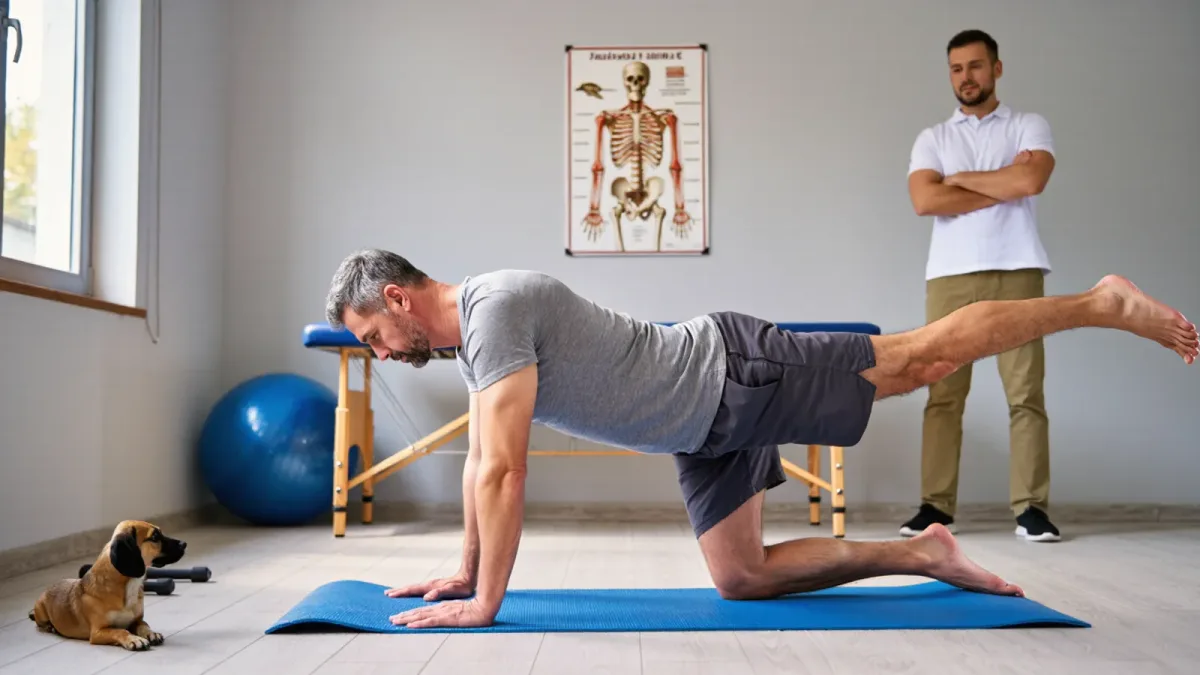
Strength work for the neck and shoulder blade muscles has the best trial support. In the 2008 Journal of Applied Physiology study, the training was five exercises with elastic bands and dumbbells, around 20 minutes per session, twice to three times per week, for 10 weeks — pain and tenderness dropped in the strength group while a control group saw no change. Those are the study's doses, not our prescription.
Commonly used exercises in that research line include shrugs, rows, and lateral raises with light-to-moderate loads, plus gentle neck flexion and extension work. Start light, leave a few reps in the tank, and progress over weeks.
Do stretches and movement breaks help?
They help the other half of the problem. Stretching will not strengthen anything, but breaking up static time is the point: short movement breaks every 30–60 minutes — look away from the screen, roll the shoulders, stand, walk to refill the water — give the working muscles a blood-flow reset. Ergonomics guidance from OSHA's workstation materials encourages exactly this rhythm of short frequent breaks.
A simple pattern that sticks: every time you send a message or join a call, stand up for the first minute of it. Anchor the break to something you already do.
How long until it feels better?
Plan on weeks, not sessions. In the cited trial, measurable change came after 10 weeks of training two to three times a week. You may feel looser after a single session and lighter days after adding breaks within a week or two — but durable change follows the training calendar, not the first good day.
What does a sensible week look like?
| Element | Common approach | Basis |
|---|---|---|
| Neck and shoulder strength work | 2–3 short sessions per week, ~20 minutes | Journal of Applied Physiology trial, 2008 |
| Movement breaks from sitting | Every 30–60 minutes, 1–2 minutes each | OSHA workstation guidance |
| Monitor setup | Arm's length away, top of screen at eye level | OSHA workstation guidance |
| Stretching | Optional, after training or breaks, holds of 10–30 s | ACSM flexibility guidance, 2018 |
Track two numbers for a month: sessions trained and breaks taken. If both go up and the ache does not move, that is professional-referral territory, not a reason to add volume.
When to see a professional
See a physical therapist or physician if pain radiates into an arm or hand, if you feel numbness, tingling, or weakness, if pain followed a whiplash-type incident, or if night pain and headaches are building rather than fading. These are signs a clinician should sort out first — desk fixes are for ordinary muscle tension, not for nerve involvement.
FAQ
Will a standing desk fix my neck?
Not by itself. A standing desk changes the position, not the static time, and the 2021 review found posture itself inconsistently linked to pain. Standing desks still help many people feel better by letting them change positions freely — but keep the strength work and breaks, because they are what the trials show moves pain.
Should I crack my own neck?
Self-manipulation gives short-term relief for some people and risks are generally low when it happens on its own — but do not force it or chase the pop repeatedly. If you feel you must crack your neck constantly, that frequency itself is a reason to get a professional assessment.
Are neck-strengthening machines at the gym worth it?
They can be, but they are not required. The cited trial used bands and dumbbells. Machines add measurable load control, which suits some lifters; elastic bands and bodyweight cover the same pattern at home. Pick the setup you will actually repeat twice a week for ten weeks.
Does stress really make neck tension worse?
Yes — studies of occupational neck pain report elevated resting muscle activity in the trapezius during mental stress, which is why deadline weeks and stiff weeks overlap. Treating the neck only mechanically misses this. Sleep, load management, and the breaks above all count as neck care.