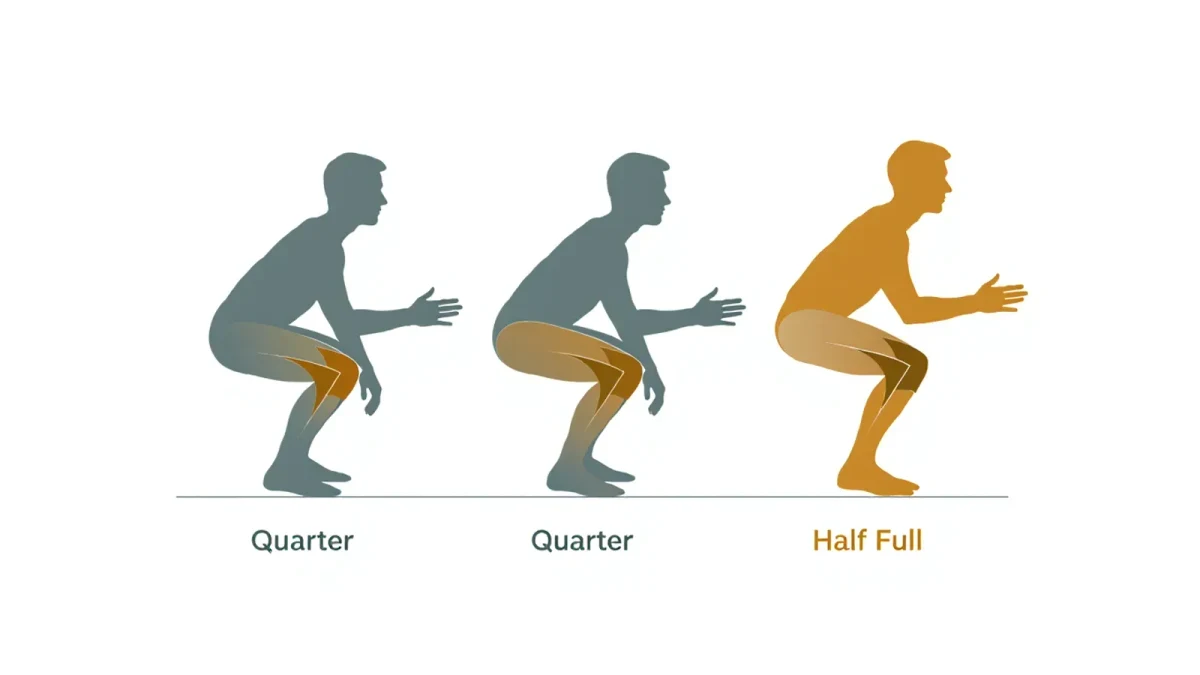

If your squat stalls above parallel with your heels lifting or your torso pitching forward, your ankles are a likely limit. Research backs the link: in a 2011 study in the Journal of Athletic Training, people with restricted ankle dorsiflexion also scored worse on dynamic balance, and lifting studies have tied limited dorsiflexion to more forward trunk lean under a bar. The fix is unglamorous — targeted ankle work 2–3 days per week, with holds of 10–30 seconds, per the ACSM's flexibility guidance (2018).
If you have pain, an ankle injury, or a medical condition, see a clinician or qualified professional before training.
Why do your ankles limit squat depth?
The squat needs the knee to travel forward over the foot. That forward travel is ankle dorsiflexion — the shin rotating over the foot. When the ankle runs out of range early, something else pays for it. Usually the torso pitches forward, the heels lift, or the feet turn out wider to buy room.
Achieve depth without the ankle range and you borrow it from somewhere else. That is the mechanism, and it is why a lifter with great hips can still squat like a folding chair.
How much dorsiflexion do you need?
Physical-therapy research commonly uses the weight-bearing lunge test, where about 10–12 cm of forward knee travel (roughly 4–5 inches) from a normal foot position is treated as a practical normal range — these are commonly used cutoffs from cited research, not our prescription. Below that, squat mechanics often start to compensate.
You can screen yourself in one minute with the wall test.
How do you test yourself?
- Face a wall and kneel or stand with one foot about 10 cm from the baseboard.
- Drive your knee toward the wall without lifting the heel or turning the foot out.
- If the knee touches, move the foot back 1 cm and repeat.
- Stop where the heel lifts or the knee cannot reach. Measure the foot-to-wall distance.
Record the number for each side. Asymmetry of more than a couple of centimeters between legs is worth knowing about, whatever the raw value.
What actually improves ankle range?
Two tools have the best support: loaded and unloaded stretching into dorsiflexion, and simply training the squat pattern with the heel supported while range builds. Commonly used doses from the cited guidance:
| Drill | Common dose | Source of the dose |
|---|---|---|
| Half-kneeling knee-to-wall stretch | 2–4 holds of 10–30 s per side | ACSM flexibility guidance, 2018 |
| Calf stretch off a step (knee straight and knee bent) | 2–4 holds of 10–30 s per position | ACSM flexibility guidance, 2018 |
| Goblet or box squat with heels on a small wedge while range builds | As technique work within normal sessions | NSCA resistance-training guidance |
Keep the heel glued down during the stretches — a stretching heel defeats the purpose. Move slowly into end range, pause, breathe, and nudge deeper. Pain is a stop signal, not a target sensation.
How long does improvement take?
Be honest with yourself: this takes weeks, not minutes. Flexibility gains from regular stretching build over a matter of weeks when the work is done most days of the week, per the ACSM's guidance (2018), which recommends flexibility exercise at least 2–3 days per week to see progress. You will often feel looser within a session; lasting range change shows up over 4–8 weeks of consistency.
One more honest note: improved ankle range helps most when you keep squatting. The motor pattern matters as much as the range — practice depth you can control, slightly less than you can reach.
What about lifting shoes and heel wedges?
Weightlifting shoes with an elevated heel effectively pre-load some dorsiflexion, letting you sit more upright at depth. That is a legitimate tool, not a cheat code. Use the shoe as scaffolding while you build range, not as a permanent crutch for an ankle you never train.
When to see a professional
See a physical therapist or sports medicine clinician if the wall test shows a big difference between sides, if a past ankle sprain still feels stiff and unstable, or if you feel pinching, catching, or pain at the front or back of the ankle during the test. Previous ankle sprains are a common cause of lasting dorsiflexion restriction, and a clinician can tell the difference between a joint restriction, soft-tissue tightness, and something that needs imaging.
FAQ
Does squatting deep damage your knees?
For healthy lifters, no — controlled studies have not shown that deep squatting harms knee health in people without existing conditions. The opposite is often true: controlled full-range work builds the tissues. If you have a knee diagnosis, clear depth targets with your clinician first.
Should I stretch my calves before or after training?
Do your main flexibility holds after training or in a separate session. Long static holds immediately before heavy lifting can briefly reduce force production, per a 2013 meta-analysis in the Scandinavian Journal of Medicine and Science in Sports. Warm up dynamically instead.
Can I just raise my heels on a plate forever?
You can, and many strong lifters do by choice. But if the goal is more ankle range, treat heel elevation as training wheels. Keep doing your ankle work, and retest the wall test every few weeks to see whether the range is actually moving.
Do foam rolling or massage help?
They can briefly improve comfort and range perception, which may let you hit better positions in the session. Treat them as a warm-up aid, not the program. The stretching and loaded range work is what produces lasting change in the cited research.