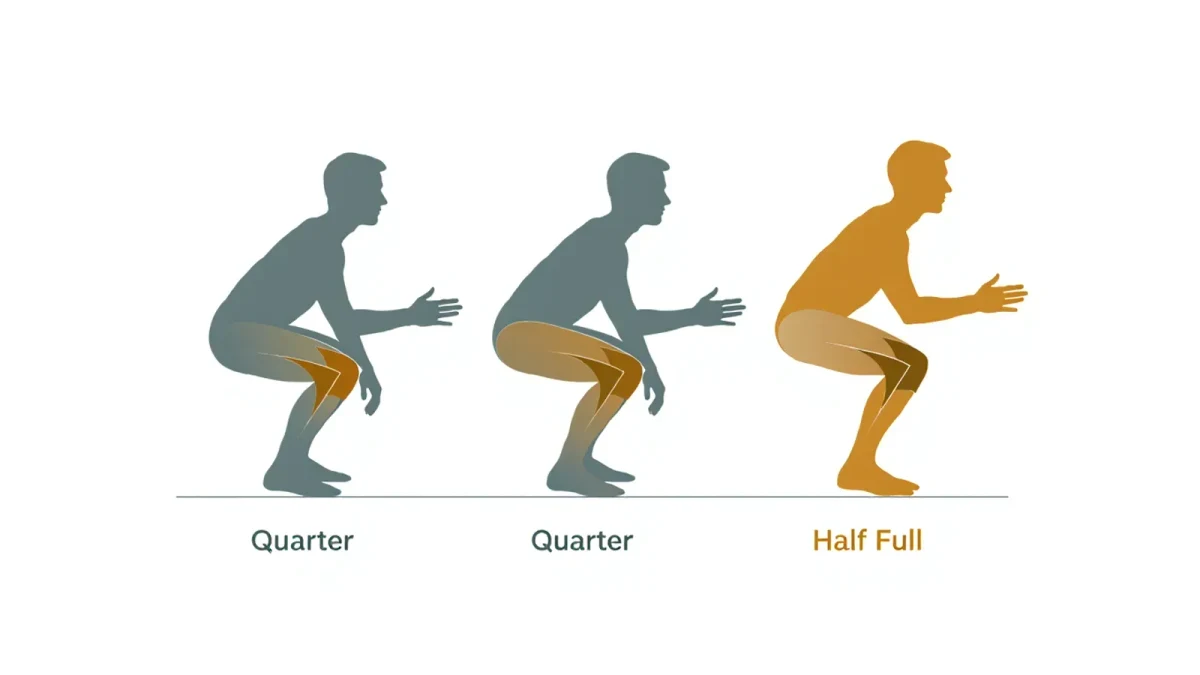

Squat as deep as you can control with a neutral spine and heels down — and accept that the last few inches may be anatomy, not effort. Hip socket depth varies widely between people: widely cited anatomical research on femoral neck variation shows acetabular depth differs enough between individuals to change available hip rotation by meaningful degrees, which is why two lifters doing identical mobility work bottom out at different depths. Train your range honestly; do not chase someone else's.
If you have hip pain, a diagnosed impingement, dysplasia, or a knee or spine condition, set your depth targets with a clinician or physical therapist before loading.
Is a deep squat safe?
For healthy trainees, the cited evidence does not support the old claim that deep squats destroy knees. A 2013 review by Hartmann and colleagues in Sports Medicine concluded that deep squatting under progressive loading did not damage knee ligaments in the studies it reviewed and found full-range training associated with favorable joint-tissue adaptation. Deep is not dangerous by default; deep without control, load you cannot handle, or a structural problem you do not know about is a different story.
How much of your depth is mobility — and how much is structure?
Separate the two before you train either. Mobility limits — stiff ankles, tight hip flexors, guarded tissue — respond to weeks of work. Structural limits do not:
- Ankle dorsiflexion. The most common trainable limit; less forward knee travel forces forward torso lean and shallower depth. Test with the knee-to-wall drill described in our earlier ankle-mobility guide's method: about 10–12 cm of knee travel is a common normal range in physical-therapy research.
- Hip flexor and posterior-chain tightness. Trainable with consistent stretching, per ACSM flexibility guidance (2018).
- Hip anatomy. Deep hip sockets (acetabular over-coverage) or shallow ones change the available range permanently. Skeletal research shows femoral neck and socket depth vary substantially between people, and a pinching sensation deep in the groin at bottom position is the classic flag — that is a structure communicating, not a stretch to override.
The practical test: work your mobility honestly for 8–12 weeks. Depth that moves was mobility. Depth that stops — especially with a pinch in the front of the hip — has likely met structure.
How do you find your own bottom position?
- Squat to bodyweight only, holding a doorframe or rack upright in front of you.
- Descend slowly to the deepest point where heels stay flat and your spine stays neutral.
- Notice the stop: a soft, stretchy end-feel suggests tissue you can train; a hard, pinching stop deep in the groin suggests bony limits.
- Squat to a box or bench set an inch above that depth, and own that depth under load.
Record where you stopped. Recheck monthly as you train. The goal is not parallel because someone said so — it is the deepest position you control, owned under load, expanding slowly if the tissue allows.
Does depth matter as much as people say?
Context matters. Full-range squatting trains more total muscle through longer muscle lengths and fuller glute range, per the Hartmann review. But partial squats with heavier loads are a legitimate tool, and strength through your trained range is what transfers to your other lifts and your life. A controlled depth below parallel is ideal; a consistently controlled depth just above parallel that you can load and progress beats a wobbly, painful bottom position you chase for years.
What does deep-squat research actually not show?
State the limits. Most depth research uses unloaded or moderately loaded protocols and young healthy participants; the very heavy loads of competitive powerlifting are less studied. The knee-safety conclusions come from training studies, not from lifelong follow-up of maximal deep squatting. And hip-structure research explains variation between people without predicting any individual's limits — imaging, not squatting folklore, settles that question.
When to see a professional
See a physical therapist or sports-medicine clinician if you feel pinching, catching, or sharp pain deep in the groin at depth; if one hip stops noticeably earlier than the other; if you have a history of hip dysplasia, impingement (FAI), or labral tears; or if knee pain — not muscle fatigue — accompanies depth work. These are the situations where forcing range does real damage.
FAQ
Are ass-to-grass squats necessary for glute growth?
Not necessary. Research comparing squat depths shows deeper ranges train glutes and adductors through longer lengths, but growth comes from progressive overload across your controlled range. Depth below your control adds risk without adding stimulus. Build depth gradually if you want it; own whatever depth you use.
Why do my heels lift at the bottom?
Usually ankle dorsiflexion — the shin cannot travel far enough forward, so the heel rises to buy the range. Test knee-to-wall, train the ankle stretches and drills 2–3 days per week per ACSM guidance, and use a small heel elevation in the meantime. Most heel lift is trainable within weeks to months.
Should I stretch my hips hard before heavy squats?
Do long static holds after training or in a separate session, per ACSM guidance — long holds immediately before heavy lifting can briefly reduce force production, per a 2013 meta-analysis in the Scandinavian Journal of Medicine and Science in Sports. Warm up with dynamic movements and ramping sets instead.
Is squatting deep bad for your knees over a lifetime?
The cited review evidence does not show harm from deep squatting in healthy, progressively trained people, and deep squats are a daily resting position in much of the world. Pain, a diagnosed condition, or uncontrolled load change the answer — those belong with a clinician, not a program.