
If your hips feel glued shut after a workday and your squat or stride pays for it, the fix is regular hip-flexor mobility work — done at least 2–3 days per week with 10–30 second holds, per the ACSM's flexibility guidance (2018) — plus fewer uninterrupted hours in the chair. Stretching alone while you sit ten hours a day is a losing math problem.
This site publishes information, not medical advice. If you have hip pain, a diagnosed condition, or a past injury, talk with a clinician or qualified professional before adding drills.
Why do desk hours tighten your hips?
Your hip flexors — chiefly the iliacus and psoas, together the iliopsoas, plus the rectus femoris — sit at the front of the hip and bring the thigh toward the torso. Sitting is that position, held for hours. Muscles adapt to the position you keep them in, so long seated hours leave them short and hesitant to lengthen.
The downstream cost shows up in training: less hip extension in stride and in squats, an anterior pelvic tilt that reads as an arch in the lower back, and the classic pinching sensation at the front of the hip when you lunge.
Is sitting really that bad, or is it hype?
Honest answer: mostly real, with nuance. Mayo Clinic's published guidance on sitting points out that long sedentary stretches are linked to worse health outcomes, and that breaking up sitting matters even for people who exercise. But tight hip flexors are not a diagnosis, and posture panic is not the goal. Treat this as maintenance, like brushing teeth — not as damage control.
There is also a catch worth knowing. A 2013 study by Moreside and McGill in BMC Musculoskeletal Disorders found that improved hip flexibility in healthy young adults did not automatically transfer into better movement during functional tasks. Range is the entry ticket; practicing the movements is what makes it stick.
Which stretches open the hip flexors?
The commonly used drills, with doses drawn from the cited guidance:
| Drill | Common dose | Cue that matters |
|---|---|---|
| Half-kneeling hip-flexor stretch | 2–4 holds of 10–30 s per side (ACSM, 2018) | Tuck the tailbone before leaning; squeeze the glute of the down-knee side |
| Couch stretch (rear foot elevated) | Start with 2 holds of 10–20 s per side | Torso tall first; only add a lean when the tuck holds |
| Standing desk break: tall kneel with glute squeeze | 3–5 holds of 10–20 s, 2–3 times per workday | Ribs down, drive the hip forward, breathe |
The tailbone tuck is the whole game. Stretch with an arched lower back and you mostly hang on ligaments and feel nothing where it counts. Tuck, then extend the hip, and the stretch lands on the iliopsoas.
How often, and how long until it helps?
Daily beats heroic. The ACSM recommends flexibility work a minimum of 2–3 days per week, with daily being most effective for gaining range. Expect the first felt-easier-squat within one to two weeks; visible, measurable change in end range typically takes 4–8 weeks of consistency. If a drill promises to "fix" you in ten minutes, close the tab.
Do strong glutes matter as much as flexible hip flexors?
Yes — probably more. Hip extension is a tug-of-war: short flexors on the front, strong glutes on the back. Two ACSM-recommended resistance days per week, including hip extension work like glute bridges, hip thrusts, or step-ups, gives the new range something to live inside. Flexibility without strength is a rented room.
Desk habits that actually help
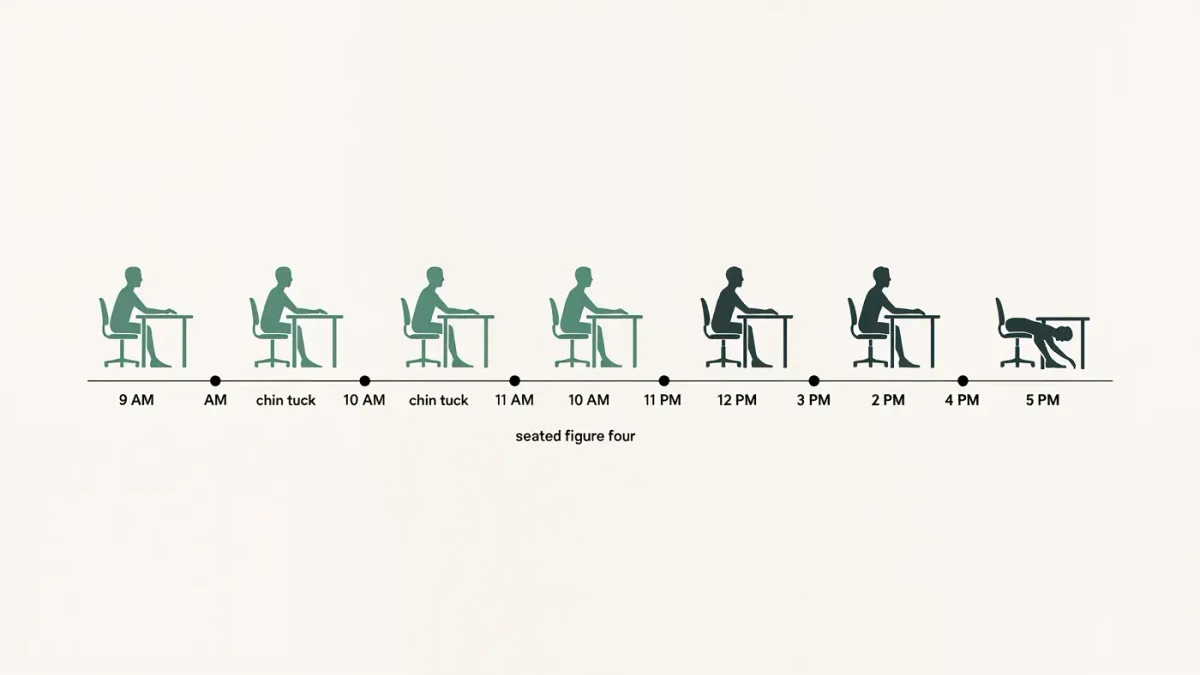
- Stand or walk for two to five minutes every 30–45 minutes of sitting; set a timer, motivation will not do it.
- Take one or two calls standing or pacing.
- Put the half-kneeling stretch into your warm-up on lifting days instead of saving it for "later".
- Check your pelvis while seated: a small forward-lean wedge or simply adjusting chair height can keep the hip angle less closed.
When to see a professional
See a physical therapist or clinician if stretching produces sharp pain, pinching at the front of the hip that persists, numbness or tingling down the leg, or if one hip is dramatically tighter than the other after an injury. Hip pain has many possible sources — joint, labrum, tendon, nerve — and a professional can tell the difference between simple shortness and something that needs specific care.
FAQ
Are my hip flexors weak or just tight?
Often both in different ways: the flexors may be short from sitting, while the glutes that oppose them are undertrained. Screening by a physical therapist can sort it out. Practically, pair the stretching with two weekly resistance sessions that include hip extension and you cover both possibilities.
Do I need a massage gun or foam roller?
They can feel good and may briefly improve comfort, which makes stretches easier to tolerate. But the lasting change in the cited research comes from regular stretching plus strength work, not from tool time. If you enjoy it before stretching, fine — just don't count it as the program.
Is the couch stretch safe for everyone?
Not as a first move for everyone. With knee issues or a very irritable hip, start with the half-kneeling version on a soft surface and earn the couch stretch over weeks. Any sharp knee pain means back off — the stretch targets the hip, and if the knee is complaining, the setup is wrong.
Should I stretch before or after work?
Both can work. Short holds during the workday break up sitting directly; longer holds after training or in the evening suit deeper range work. What matters is frequency across the week — the ACSM's 2018 guidance rewards 2–3 days minimum, daily for best results.