
Creatine monohydrate is the best-studied supplement in sports nutrition, and the short version is this: a 2017 position stand from the International Society of Sports Nutrition calls it one of the most effective legal supplements for improving high-intensity exercise capacity and increasing training volume, with typical gains of roughly 1–2 kg in body mass over the first weeks, mostly water held inside muscle cells. It helps repeated hard efforts. It does not replace training, and results vary by person.
Supplements can interact with medications and health conditions — clear any supplement with a clinician or pharmacist before you start, especially if you take one already.
What does creatine actually do?
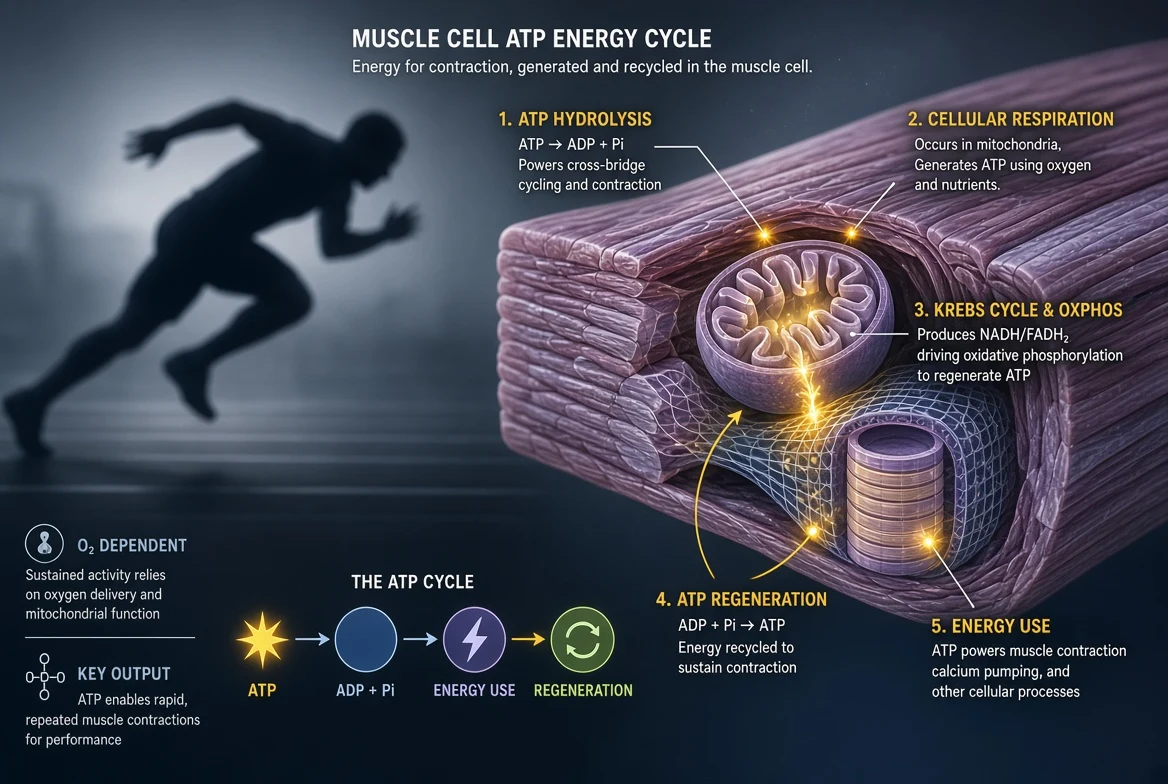
Your muscles run on a fuel called ATP. During a hard set of six to twelve reps, ATP drains fast, and your body refills it using a backup system built on phosphocreatine. Creatine supplementation raises your phosphocreatine stores — roughly 20–40 percent higher after loading, per the ISSN position stand — which lets you squeeze out a bit more work per set and recover a little faster between sets.
That extra work compounds. Over weeks of training, more total volume tends to mean more strength and more muscle than training alone produces. A 2003 meta-analysis in Molecular and Cellular Biochemistry by Rawson and Volek found creatine users added roughly 8 percent more strength and 14 percent more reps-to-fatigue on average than placebo groups during resistance training.
How do you take it?
Two commonly used protocols appear in the cited literature:
| Approach | Dose | Notes from the research |
|---|---|---|
| Loading | ~20 g/day (4 × 5 g) for 5–7 days, then 3–5 g/day | Fills stores in about a week; more stomach upset possible |
| No loading | 3–5 g/day every day | Fills stores in about 3–4 weeks; simpler, cheaper |
These are commonly used ranges from the ISSN position stand, not our prescription. Timing within the day has not been shown to matter much — consistency does. Monohydrate is the form with decades of safety data; the ISSN notes other forms have not been shown to outperform it.
Who responds best — and who barely responds?
Roughly 20–30 percent of people are non-responders, per research summarized in the ISSN stand, often because they already carry high muscle creatine stores. Vegetarians tend to respond more strongly, since their baseline stores are lower. If nothing changes after a month of daily monohydrate, the honest answer is that it may not add much for you.
What the evidence does not show
State it plainly and move on:
- It is not an endurance aid in the way it is a sprint-and-strength aid. Long steady efforts depend on different fuel systems.
- It is not a body-fat tool. Early weight gain is water, per the cited literature.
- The early 1990s scare stories about kidney damage have not been supported in healthy people across long-term studies, per the ISSN's review — but that statement covers healthy people, not those with existing kidney disease.
Is creatine safe? What is actually contested?
For healthy adults, the ISSN position stand concludes short- and long-term supplementation (up to 30 g/day for 5 years in the studies it cites) shows no consistent adverse effects. Reported side effects are mostly water-weight gain and occasional stomach discomfort with large single doses.
Two areas stay genuinely contested. First, creatine in adolescents: the ISSN notes creatine is legally sold to minors in many places, but several professional bodies, including the American Academy of Pediatrics' council on sports medicine, advise against supplement use in growing athletes outside clinical supervision — the long-term data in adolescents simply do not exist. Second, claims that creatine improves cognition or helps depression are emerging and preliminary, based mostly on small trials; treat them as open questions, not established facts.
Does the water weight matter?
You will likely gain 1–2 kg in the first weeks, mostly intracellular water inside muscle, per the ISSN stand. For most lifters this is cosmetic trivia. For weight-class athletes or anyone whose sport punishes extra mass, it is a real decision, not a side note. Weigh the benefit to your training against the weight of the number on the scale.
What about cycling off?
There is no evidence you need to cycle creatine, per the ISSN position stand. Stores decline back to baseline over about 4–6 weeks after stopping. Some people take breaks for cost or preference; the research does not require it, and it does not show a benefit from rotating brands or stacking forms.
What about creatine and women?
The evidence supports creatine for women, with one honest caveat about dosing research. The ISSN position stand notes women have been underrepresented in creatine trials, so the classic dose ranges were built mostly on male participants; body-size scaling suggests many women need less absolute grams to reach the same muscle saturation. What trials that did include women show — including resistance-training studies reviewed in the ISSN stand — is the same pattern as men: increased training volume, small water-weight gain, modest strength advantage over placebo. Pregnancy and breastfeeding change the answer entirely; the NIH Office of Dietary Supplements states the safety data there are insufficient, which makes clinician guidance non-optional in those periods rather than cautious boilerplate.
When to see a professional
Blood tests can read higher creatinine — a breakdown product — in supplement users, which is worth mentioning to your doctor so a lab result is not misread.