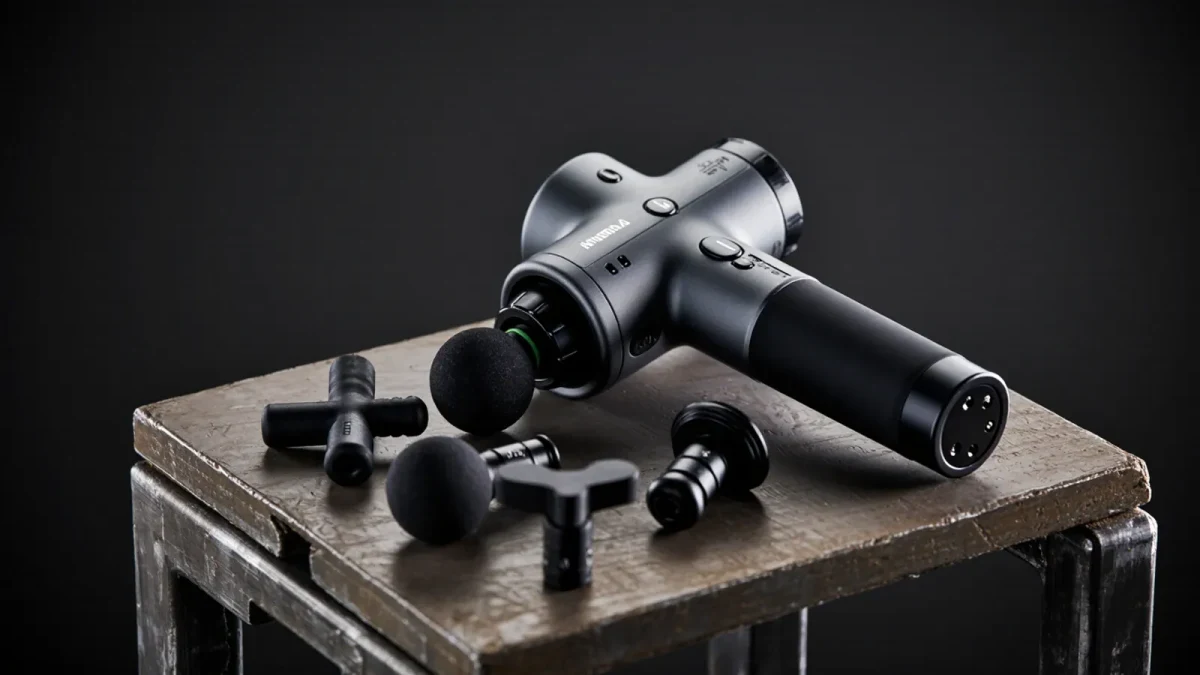

A massage gun can genuinely help you feel looser for a while — but the honest evidence is thinner than the marketing. The strongest research on percussive-style recovery comes from the broader massage literature: a 2019 systematic review and meta-analysis by Wiewelhove and colleagues in Sports Medicine found massage and roller-based recovery tools modestly improved recovery and reduced soreness after hard exercise. Direct trials on percussive devices are newer, smaller, and mostly measure short-term changes in range of motion and tenderness — not long-term outcomes.
Do not use a massage gun over injuries, bruises, varicose veins, blood-thinning medication territory, or anywhere near the neck's front and sides — and ask a clinician first if a medical condition is in the picture.
What are the actual claims, and what supports them?
Massage guns deliver rapid pulses of pressure — commonly 2,000–3,200 percussions per minute on current consumer specs, which manufacturers state. The claims attached to them run ahead of the data in places, so sort them honestly:
- Claim: it reduces soreness after training. Plausibly supported by analogy: massage broadly showed modest soreness reduction in the Wiewelhove meta-analysis (2019). Device-specific confirmations are small trials, not large independent replications.
- Claim: it improves range of motion. The best-supported effect. Early percussion trials and the broader pressure-therapy literature both show short-term flexibility improvements, in the same family as foam rolling's documented range-of-motion effect (Cheatham et al., 2015).
- Claim: it flushes lactate or accelerates healing. Not demonstrated. The reviewed massage research did not show meaningful lactate clearance advantages, and no device trial has shown faster tissue repair.
- Claim: it breaks up scar tissue and fascia. No. No study has shown a percussive device restructuring tissue — the same neurological explanation that applies to rolling applies here: pressure temporarily reduces tissue sensitivity.
What the sources did not establish
Read the fine print on both sides of this debate:
- No large long-term trials. The percussion-specific studies that exist are small, brief, and often partly funded by device makers. Independent replication is scarce.
- No head-to-head proof of superiority. No solid evidence shows a massage gun outperforms hands-on massage, a foam roller, or simple walking for the same purpose.
- No recovery-by-proxy. Feeling looser for 20 minutes is not the same as recovering faster — the trials that measured next-day soreness with recovery tools found modest effects at best (Wiewelhove et al., 2019).
The fair summary: a massage gun is a pressure tool with a delivery mechanism. The documented benefits of pressure tools are real, modest, and short-lived. The device-specific hype is not evidence.
How should you use one, if you buy one?
Use the protocol shape the pressure-therapy research supports: short, tolerable, muscle-belly only.
- Target the muscle you trained, not joints, bones, or the spine.
- Keep the head moving slowly across the muscle — 30–60 seconds per group.
- Set intensity at pressure you can breathe through; wincing works against the relaxation effect you are chasing.
- Skip bony points, the front and sides of the neck, and any recent injury site entirely.
- Stop on numbness, tingling, or sharp pain — those are stop signals, not "knots releasing."
Massage gun vs foam roller vs plain rest
| Tool | What the evidence shows | Cost |
|---|---|---|
| Massage gun | Short-term range-of-motion and tenderness relief in small trials; device-specific long-term data absent | $100–600 |
| Foam roller | Range-of-motion gains and modest soreness reduction, meta-analyzed (Wiewelhove et al., 2019) | $15–40 |
| Easy walking | Improved perceived recovery and byproduct clearance per the active-recovery review (Ortiz et al., 2018) | Free |
That table is the buying decision in three rows. If you enjoy the device and it fits your budget, it is a legitimate comfort tool. If the question is which option the evidence favors per dollar, the roller and the walk are hard to beat.
Who should skip massage guns entirely?
- Anyone on blood thinners, or with a bleeding or clotting disorder.
- Anyone with deep vein thrombosis, active infection, or cancer treatment — pressure therapy is contraindicated, per clinical massage guidance.
- Anyone with an acute injury, sprain, or unexplained swelling — get a diagnosis before applying pulses to it.
When to see a professional
See a physical therapist or clinician if pain persists more than a week, if one spot stays tender no matter what you apply to it, or if you feel numbness or radiating pain. Persistent symptoms need an assessment, not more percussion — and a device used on an undiagnosed injury can make the weeks ahead longer, not shorter.
FAQ
Do massage guns actually help recovery?
Modestly and briefly, if the broader pressure-therapy evidence carries over. The Wiewelhove meta-analysis (Sports Medicine, 2019) found massage-family tools modestly improved recovery and soreness after exercise. Device-specific trials are smaller and shorter, so treat the massage gun as a convenient way to apply a modestly supported intervention — not a step change in recovery.
Is a massage gun better than foam rolling?
No trial has shown that. Both apply pressure and produce similar short-term effects: better range of motion and reduced tenderness. The roller has the larger, independently published evidence base and costs a fraction of the price. The gun's advantages are convenience and reaching areas like shoulders — comfort features, not documented performance features.
How long should I use a massage gun on one muscle?
Thirty to sixty seconds per muscle group, matching the protocol shape used in pressure-therapy research. Longer sessions add soreness risk, not benefit. Keep it off joints, bones, the spine, and the front and sides of the neck, and stop if you feel numbness or sharp pain rather than comfortable pressure.