The recovery position is a side-lying body position used for an unconscious person who is breathing. It keeps the airway open and lets fluid or vomit drain from the mouth instead of pooling in the throat. Knowing it matters because an unresponsive person who is left flat on their back can have their airway blocked by their own tongue.
Here is the honest qualification up front: this article explains the position in plain terms so you understand what it does and roughly how it is done. It is not a substitute for hands-on training. A certified first-aid or CPR course, where an instructor corrects your hand placement on a real person, is the only way to make this skill reliable under stress. The word matters here, too. According to Dictionary.com, to use something is "to employ for some purpose; put into service" — and the recovery position is exactly that: a tool you put into service in one specific situation, not a general comfort position.
This piece sits in our recovery coverage, which usually means sleep, soreness, and rest days. This is the other end of recovery: the minutes right after something goes wrong. For the everyday version — how rest rebuilds a trained body — see our guide on Sleep Is the Recovery Tool With the Strongest Evidence.
What is the recovery position, and why does it work?
The recovery position is a stable position on the person's side, with the head tilted so the mouth points slightly downward. That single arrangement solves three problems at once. Gravity keeps the tongue from falling back into the throat. Fluid drains out of the mouth rather than into the airway. And the body is less likely to roll onto the face.
The mechanism is simple anatomy. In an unconscious person, the muscles that normally hold the tongue and soft palate forward go slack. Flat on the back, that relaxed tissue can settle into the airway. Turned on the side with the head supported, the same tissue shifts forward and out of the way. That is the whole idea — no equipment, no strength, just gravity working for you instead of against you.
When should you use it — and when should you not?
Use the recovery position for a person who is unconscious but breathing normally. Those two conditions go together. Unconscious and not breathing means you shift to CPR and emergency services, not the recovery position. Conscious and responsive means the person can usually protect their own airway, and you should talk to them, keep them still, and get help as needed.
There are situations where moving a person is the wrong first move, particularly if a fall or collision suggests a spinal injury. In that case, the general principle taught in first-aid training is to keep the person still and support the head unless the airway is at risk — and an airway at risk always takes priority. This is one of the judgment calls an instructor walks you through, and one more reason a certified course is worth the time.
Call emergency services before or while you position someone. In the United States, that means 911. Do not wait to see whether the person "comes around." An unresponsive person needs professional assessment regardless of how quickly they wake.
How do you put someone in the recovery position?
Think of it as four moves. The exact hand placements vary slightly between first-aid organizations and course versions, which is normal — the goal is the outcome, not a single choreography.
- Kneel beside the person. Check that they are breathing before anything else. If they are not, this is not a recovery-position situation.
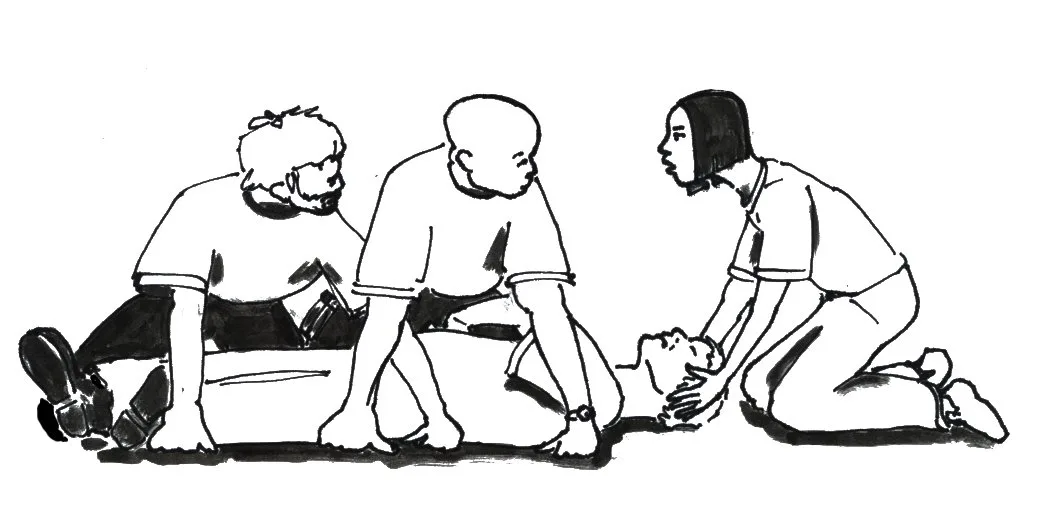
- Position the near arm. Bring the arm closest to you up so the hand rests near the head, roughly in a salute. This arm becomes the support the body will rest on.
- Bring the far side over. Lift the far knee to a bent position, place the back of that hand against the person's near cheek, and use the knee as a lever to roll the person gently toward you onto their side. The bent knee and the tucked arm hold the position.
- Open the airway and check. Tilt the head back slightly so the mouth points toward the ground, and adjust the top leg so the person is stable and will not roll. Then keep checking breathing until help arrives.
Two habits make this stick. First, say the steps out loud when you practice — verbal rehearsal is what survives panic. Second, practice on a willing adult at home, slowly, with no pressure. Speed comes later. Accuracy comes first.
What are the common mistakes people make under pressure?
Real-world errors cluster into a short list, and each one has a simple fix.
- Skipping the breathing check. The most serious mistake. If the person is not breathing, the recovery position does nothing and the minutes spent positioning them are minutes lost.
- Placing the person face-down or half-twisted. A collapsed position can press the chest and make breathing harder. The person should rest solidly on their side, not balanced on a shoulder.
- Tilting the head the wrong way. If the face points up or the chin tucks toward the chest, the airway benefit is gone. The mouth should be angled toward the floor.
- Leaving to get help and not coming back. Once positioned, stay. Breathing can change. If you must leave to call for help, return immediately and keep checking.
- Forgetting your own safety. Check the scene first — traffic, glass, water, electricity. A second casualty helps nobody.
One more, quieter mistake: freezing because you are afraid of doing it wrong. A rough recovery position applied promptly is far better than a textbook-perfect one applied never. First-aid instructors make this point constantly, because hesitation is the most common failure of all.
When to see a professional
Any loss of consciousness deserves medical follow-up, even if the person wakes quickly and insists they are fine. Fainting, a head strike, a seizure, or an unexplained collapse are all reasons for a clinician to assess what happened. If the person has trouble breathing, chest pain, confusion, or persistent drowsiness after waking, treat that as urgent. And if you have never taken a first-aid course, this is the practical takeaway: find a certified course through a recognized provider such as a national first-aid organization, your workplace, or a local CPR training center. The recovery position is a skill you learn once and carry for life.
What this means for you
Our analysis of what actually goes wrong in first-aid situations points to one conclusion: the technique is the easy part. The hard parts are the checks before and after — breathing first, emergency services early, monitoring after. Learn the four moves, rehearse them at home, and get certified so the judgment calls are already made before you ever need them. The recovery position is not complicated. It is just a side-lying position with a job to do, and it works because you put it into service at the right moment, for the right person, in the right way. Readers following this should also see Sore Muscles After a Hard Workout? Here's What the Evidence Says Helps.